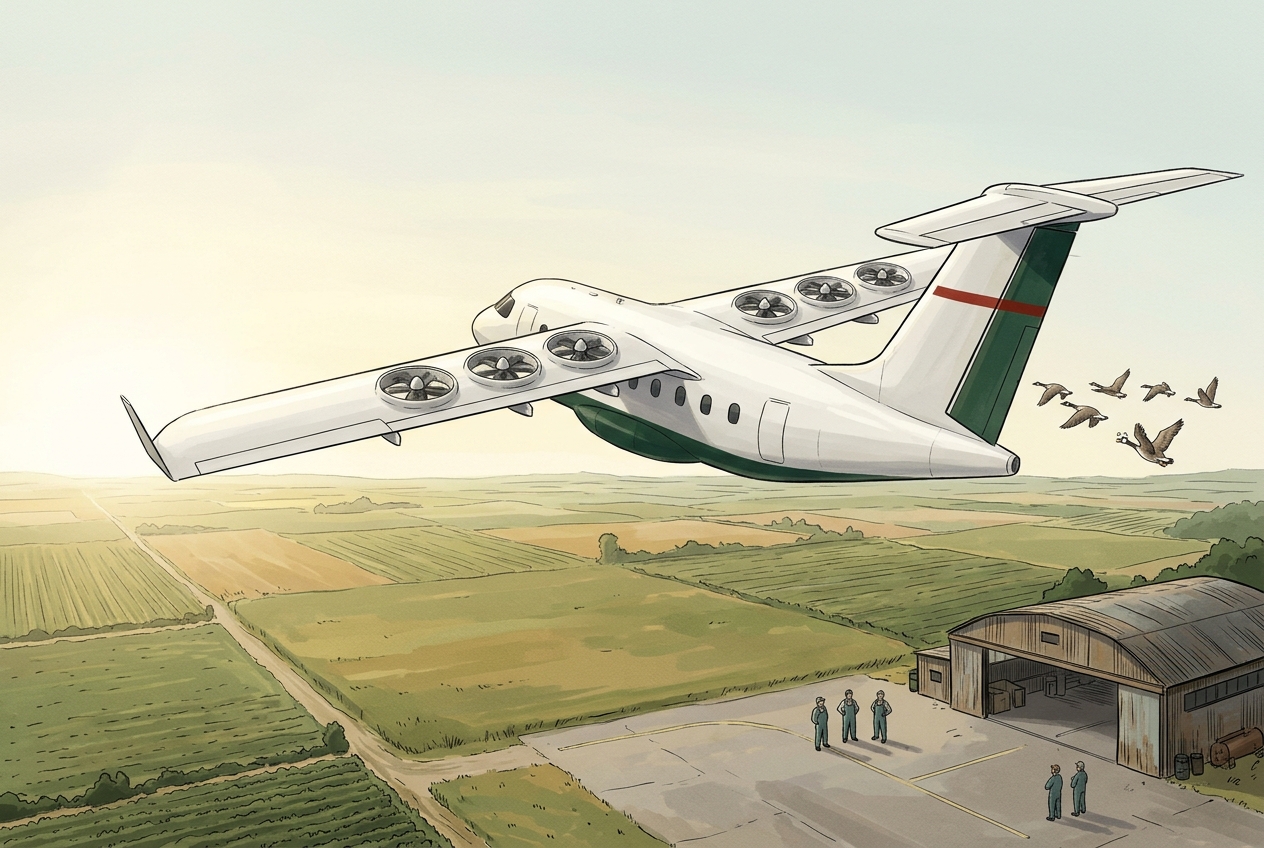
On Saturday 14 November a white aircraft with a row of small fans along the top of each wing took off from Binzhou, in China’s Shandong province, with two pilots and a flight test engineer on board. It was in the air for 16 minutes and 38 seconds and covered about 60 kilometres. No kerosene was involved.
The plane is the CE-25A, built by the state aircraft maker COMAC, and it is the first 19-seat battery-electric airliner to fly with people on board. Until now, crewed electric flight meant two-seat trainers, like the Pipistrel Velis that European regulators approved in 2020, or small four-seaters. The CE-25A had already made 19 flights without a crew since 2 February.
On paper it is a regional commuter: 19 passengers, a cruising speed of 300 km/h at around 2,400 metres, and a range of 400 kilometres, a little more than Amsterdam to Frankfurt as the crow flies. Those figures come from COMAC and the Civil Aviation Administration of China, and none of them has been shown in flight yet. COMAC has not said what is in the battery, how long it takes to charge, or whether the range includes the reserve every airliner must carry. Battery maker CATL is a partner in the venture behind it.
What makes this more than a demonstration: on 16 November the Chinese regulator accepted COMAC’s application for a type certificate, the approval an aircraft needs before it may carry paying passengers. No date has been given for that.
Europe is working on its own answer, partly in the Netherlands. Elysian, a start-up with a lab beside Schiphol, is designing the E9X with researchers from TU Delft: around 90 seats, six propellers, about 40 battery packs in a wing more than 50 metres wide, and a target range of 800 to 1,000 kilometres. KLM and Transavia are studying how they would use it. A scale model has flown with Germany’s DLR; the real aircraft is planned for 2034.
So the electric airliner is not here yet. But since Saturday, one of them has had people in the cockpit.