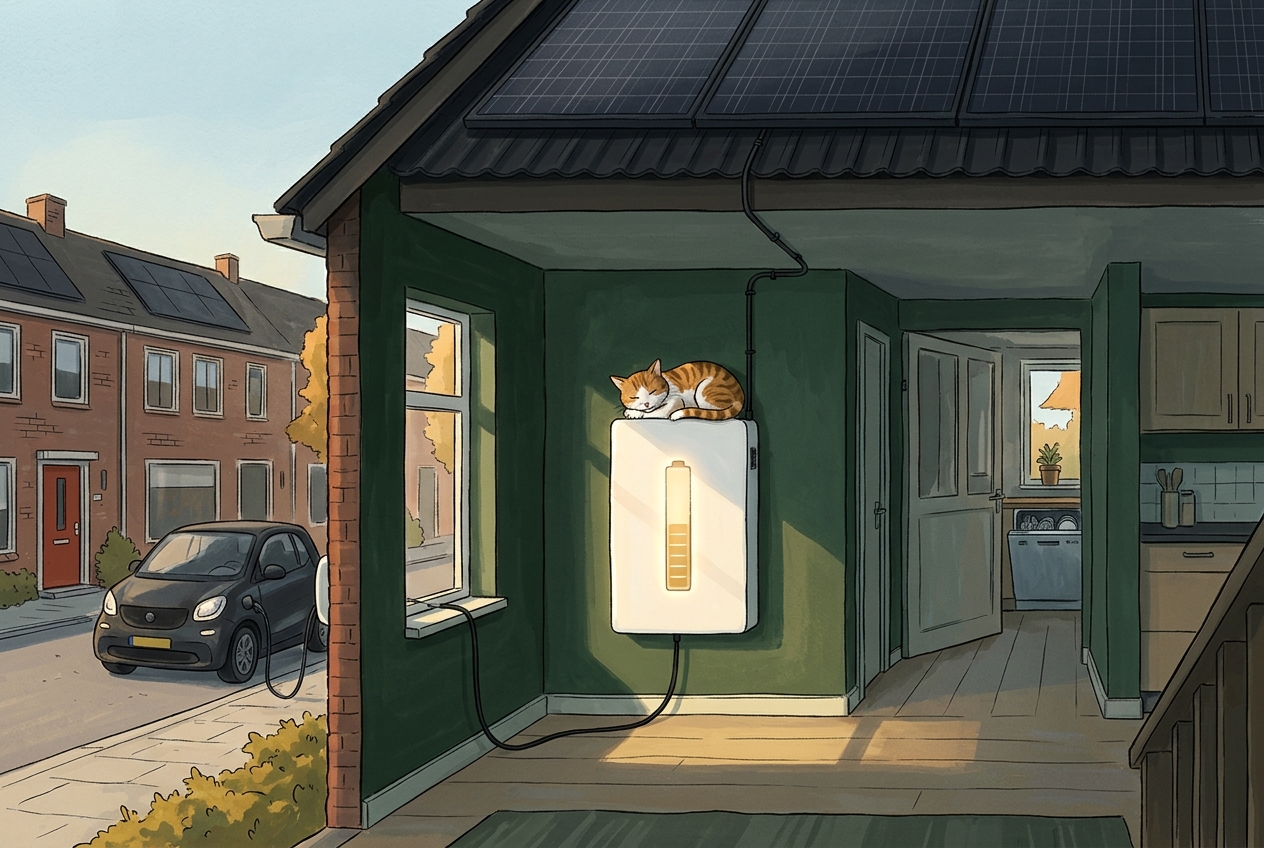
At the end of October 2025 about 20,000 home batteries were connected to the Dutch grid. A year later there are about 89,000, the Authority for Consumers and Markets (ACM) reported in its Energy Monitor last week. Registered battery capacity rose from 0.3 to about 1.1 gigawatts. The real number is probably higher still: small plug-in batteries often never get reported to the grid operator.
The reason is a date. On 1 January 2027 the salderingsregeling ends. For years, households with solar panels could subtract every kilowatt-hour they fed into the grid at noon from what they took back in the evening, at full price. The grid worked as a free battery. From New Year’s Day, power you send back earns only a modest feed-in payment, and many suppliers already charge feed-in costs on top. A kilowatt-hour you store yourself and use after dark is suddenly worth much more than one you give away.
So the sunny afternoon now goes into a box in the hallway or the garage. That changes the household routine in small ways: the dishwasher and the electric car follow the battery rather than the clock, and an app on the phone shows how full the house is.
There may be a bonus for everyone else. The ACM counted just over 400 hours of negative electricity prices so far this year, fewer than in each of the past two years. On sunny days too much solar power floods the grid, and producers pay to get rid of it. The regulator suggests that batteries soaking up the midday surplus may be part of why the count went down, though it stops short of a firm conclusion.
There is a caution, too. A battery typically costs thousands of euros, and whether it pays back depends on your panels, your contract and your habits. The ACM advises households to check their energy contract before 1 January, because feed-in costs differ widely between suppliers. It also warns about door-to-door and telephone sellers who press people into expensive purchases. Its advice comes down to this: compare first, sign later.
For the grid, a nation of small batteries is good news. For each household, it is now a sum worth doing on a calm evening, with the contract on the table.