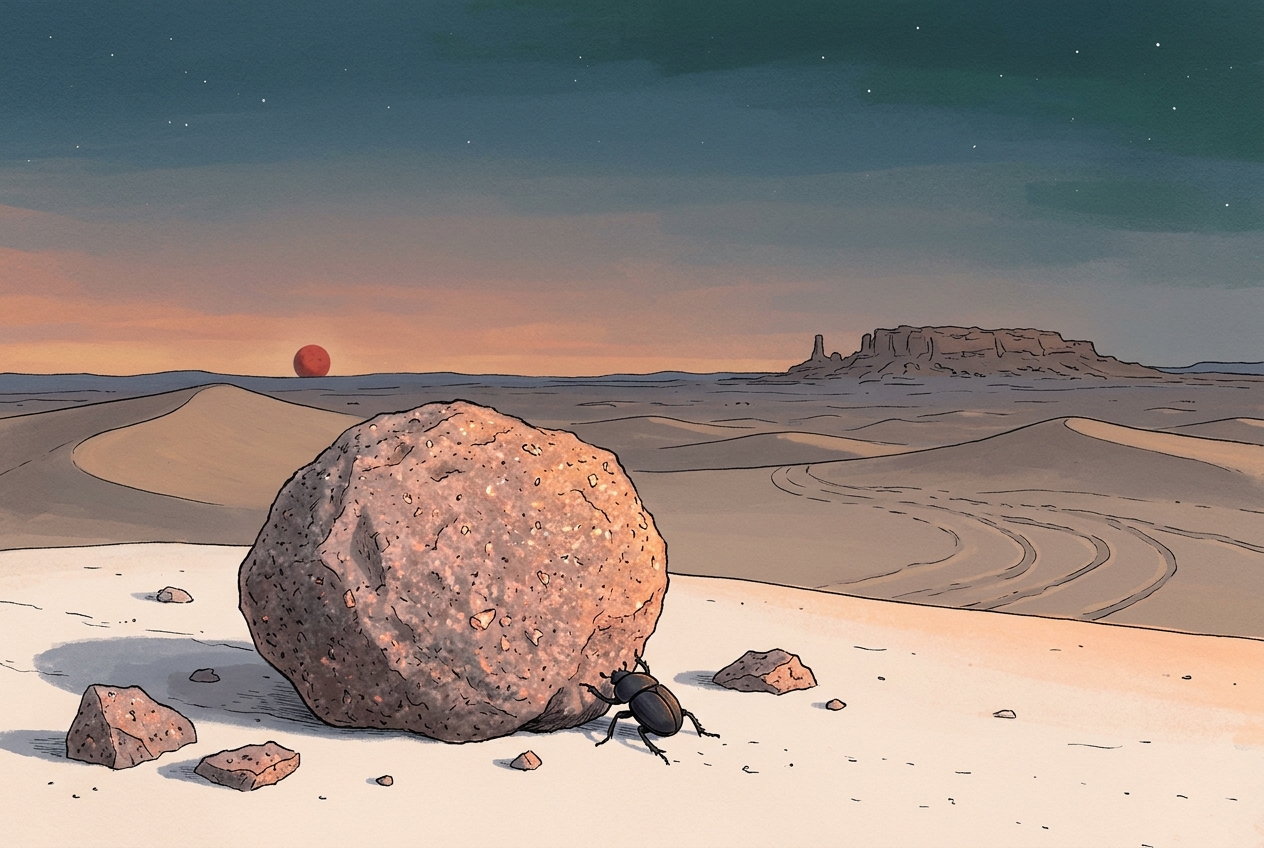
In 2022 prospectors in the Sahara, in Mali, about 34 kilometres from the village of Bir Chali, picked up eight pieces of an unusual stone, the largest about the size of a fist. Together they weigh some 800 grams. Scientists have now worked out what the pieces are, Reuters reported this week: a fragment of Mars at least 4.1 billion years old, and perhaps the oldest of the 435 Martian meteorites known on Earth.
The stone, named Teghaza 001, was blasted off Mars by an impact and eventually fell in the desert. Tiny zircon crystals inside it contain uranium, which decays into lead at a known rate: a natural clock. That clock says 4.1 billion years, and possibly more, because heat or water can reset it.
The age is not the only surprise. Most of Mars is dark volcanic basalt. Teghaza 001 is a coarse-grained, silica-rich rock that resembles granite, the stuff of continents on Earth. “It’s very strange; we don’t expect that,” said planetary scientist Eva Scheller of Stanford. If early Mars made granite-like crust, it was a more complicated place than its red dust suggests.
And there is water. “Multiple lines of evidence in Teghaza 001 suggest Mars’ surface had water at more than 4.1 billion years ago,” said lead author Yang Liu of NASA’s Jet Propulsion Laboratory. The rock also hints that young Mars lost much of its first atmosphere to space within a few hundred million years: the start of the long drying out that left the planet we see today.
Only a handful of Martian meteorites come from that first chapter. The best known, ALH 84001, found in Antarctica in 1984, turns out to be about the same age; Teghaza 001 is probably a little older. A prospector in Mali, it turns out, can pick up four billion years without bending very far.
The pieces now belong to the Maine Mineral and Gem Museum in the United States.