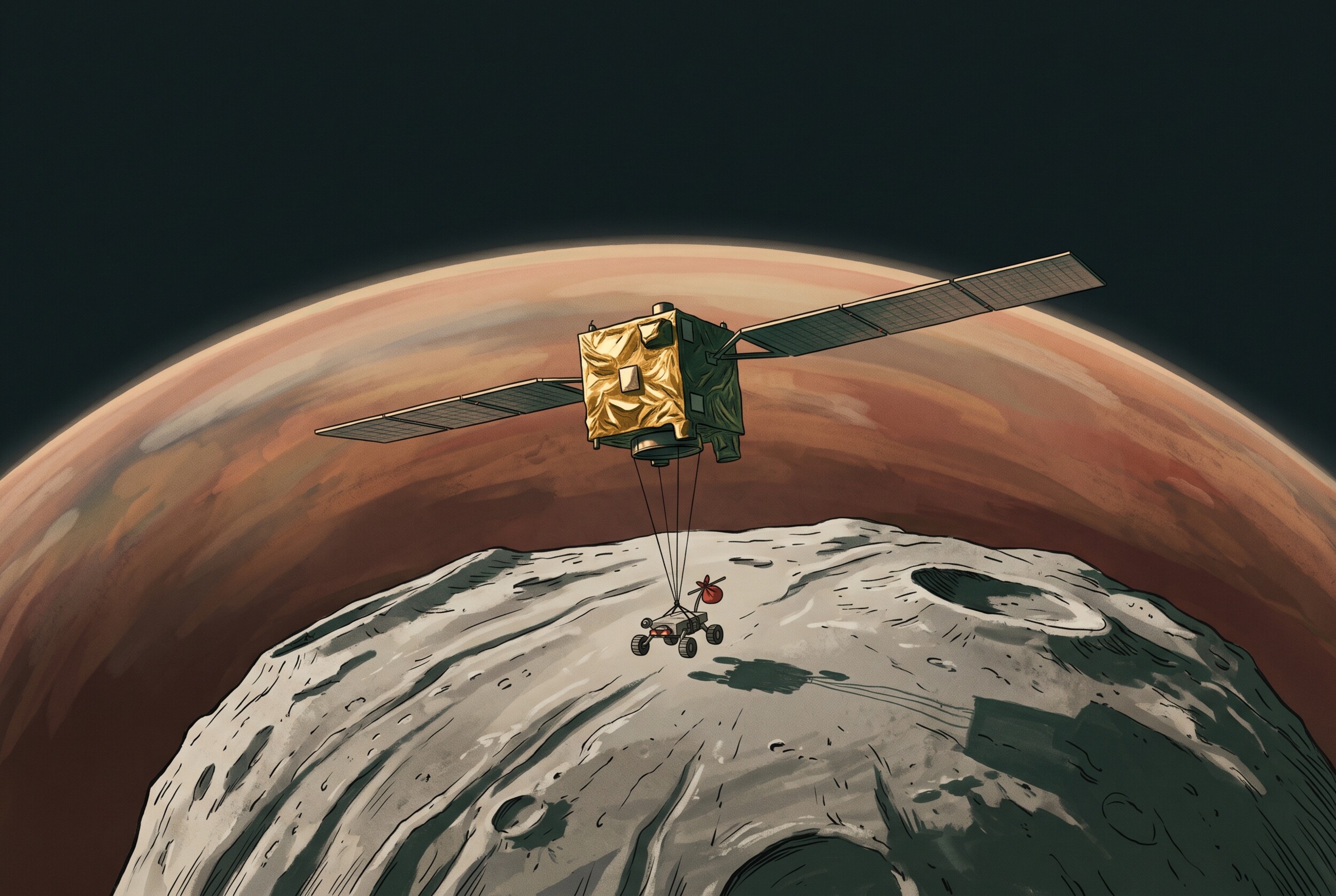
On Monday evening at 21:41 Dutch time, a Japanese H3 rocket lifted off from Tanegashima, an island off the south of Japan. On top sat MMX, short for Martian Moons eXploration. Its job sounds simple: fly to Phobos, the larger of Mars’s two little moons, pick up some dust and bring it home.
Nobody has done that before. Rovers have driven across Mars and probes have photographed its moons from a distance, but no one has ever touched one, let alone brought a piece back.
Phobos is an odd thing. It is a lumpy grey rock about 27 kilometres across, which circles Mars in under eight hours, closer than any other moon to its planet. Scientists still argue about where it came from. Is it an asteroid that strayed too close and got caught? Or is it debris from a giant collision that knocked a chunk off young Mars? A sample would settle it, and the answer says something about how planets, including our own, were built.
The trip takes time. MMX should reach Mars in August 2027 and settle into orbit around Phobos a month later. In 2029 it drops Idefix, a rover built by the French and German space agencies CNES and DLR. On Earth Idefix weighs 25 kilograms. On Phobos, where gravity is barely there, it weighs about 15 grams. Its wheels must cope with a surface where a careless step could send it drifting off.
Then the main probe lands, scoops up about 10 grams of soil and heads home. If all goes to plan, the sample lands on Earth in 2031. The European Space Agency is a partner, and European scientists will get to work on the material.
There is a practical side too. The mission is meant to help plan future crewed trips to Mars, and anyone who ever visits Phobos will want to know what its surface is made of and how its dust behaves. Idefix’s soil measurements are as much a scouting report as a science experiment.
Japan has done this before, on a smaller scale: its Hayabusa2 probe brought grains of the asteroid Ryugu to Earth in 2020. MMX goes further: five years from launch to lab, for a few spoonfuls of dust.