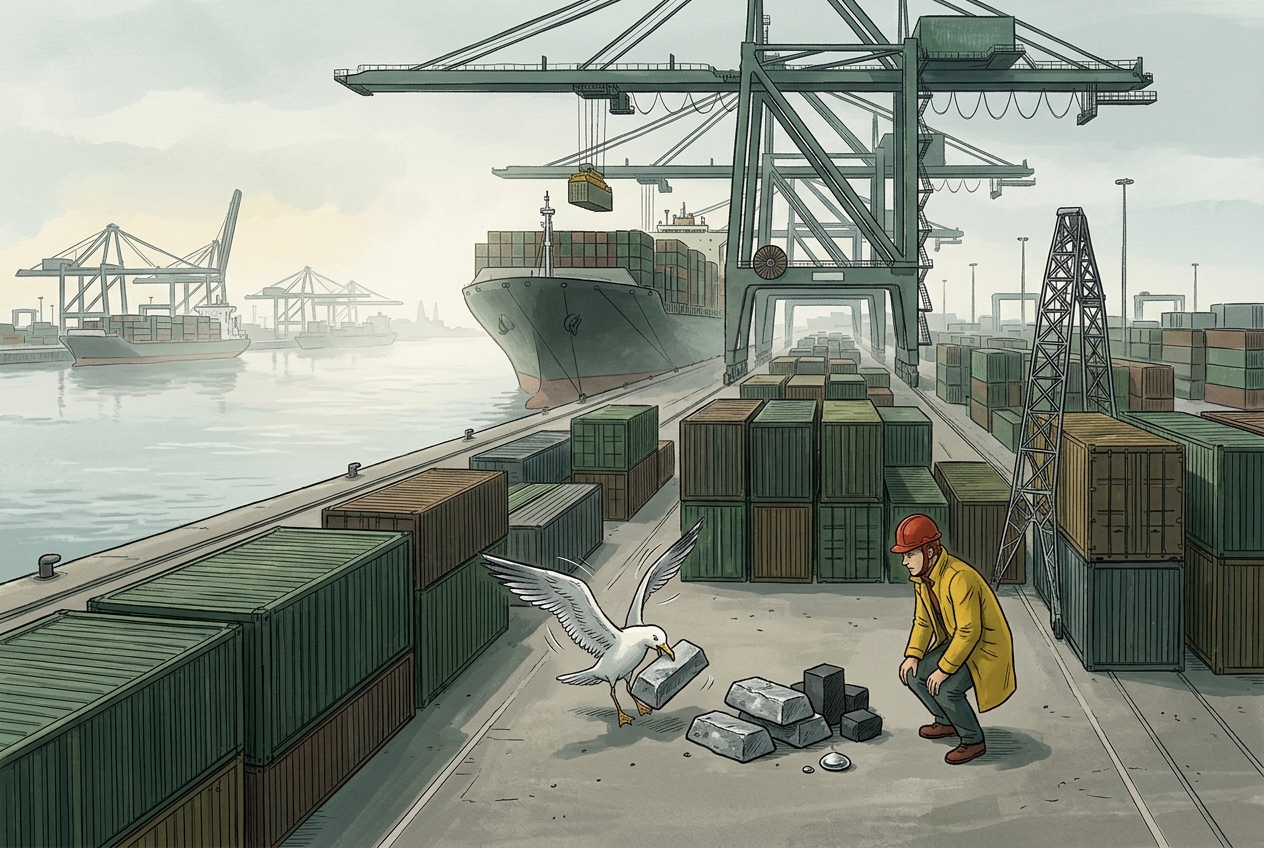
Your phone, the chip in your laptop, the battery in an electric car: they all depend on a short list of metals most people never see. On Thursday Statistics Netherlands (CBS) published a ranking of which of these matter most to the Dutch economy, and where they come from. The answer is mostly one country.
CBS ranked more than thirty materials from the EU’s list of critical raw materials by three things: how important they are to the Netherlands, how likely supply is to be disrupted, and how fast demand will grow. Top of the list is gallium, the basis of microchips. Then come rare earth metals, germanium, graphite, lithium, cobalt, niobium and silicon metal.
For seven of those eight, China handles at least 74% of global processing. For gallium it is 99%, for graphite 94%, for rare earths 84%. Only niobium comes mainly from elsewhere, Brazil. And China, CBS notes, uses strict export restrictions as political leverage.
The sums are not small. In 2025 the Netherlands imported €17.2 billion worth of critical raw materials from outside the EU, plus €123.9 billion of products that contain them: almost a third of the value of everything it imports from outside the EU. Demand is rising, driven by AI chips, electric cars, faster networks and new defence systems.
None of this is new to a chip engineer. What is new is that the dependency now has a number, and the number is uncomfortable.