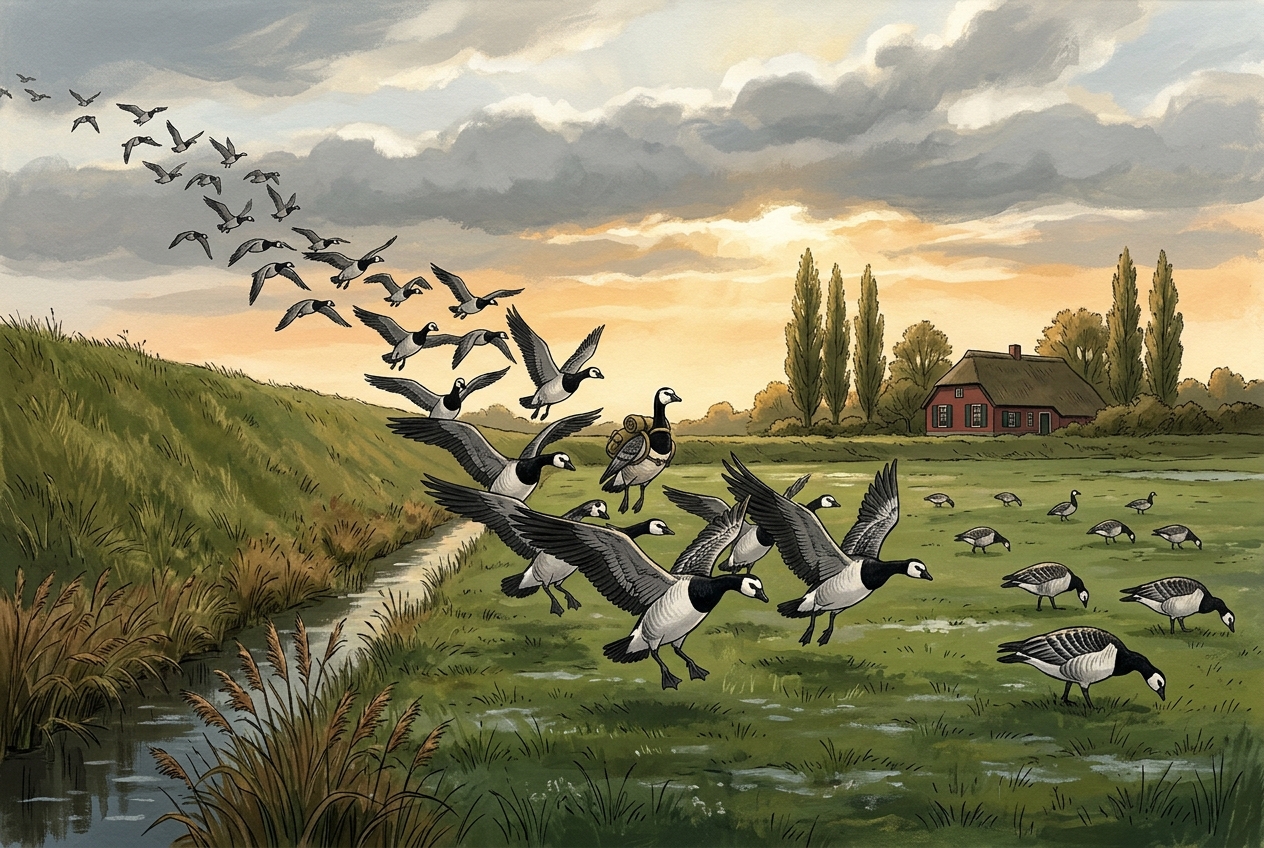
Look up in the coming weeks and you may hear them before you see them: a yapping, almost puppy-like chatter high overhead. Barnacle geese are coming back. The first have already landed; most are still resting in Sweden and Finland and will arrive in November and early December, according to Nature Today’s nature journal of 24 October.
The Netherlands has become their winter home. Since the 1980s the geese have discovered Dutch grassland, and today about eighty percent of the migrating birds spend the winter here, grazing in noisy black-and-white flocks along the coast and in the polders. In spring they stay longer than they used to, before flying back to breeding grounds as far away as Novaya Zemlya in the Russian Arctic, where the climate is warming about twice as fast as the world average.
And some don’t go at all. More and more barnacle geese now stay in the Netherlands to breed, raising their goslings within sight of a dyke instead of a glacier. For a bird named after a medieval belief that it grew from barnacles on driftwood, that is quite a change of habits.
So this winter’s flocks are a small piece of good news with a question attached: a species doing well because it has found us, and because its old home is changing.